Illustration of the replicative helicase detecting a toxic DNA lesion and triggering its repair in frog egg extracts.
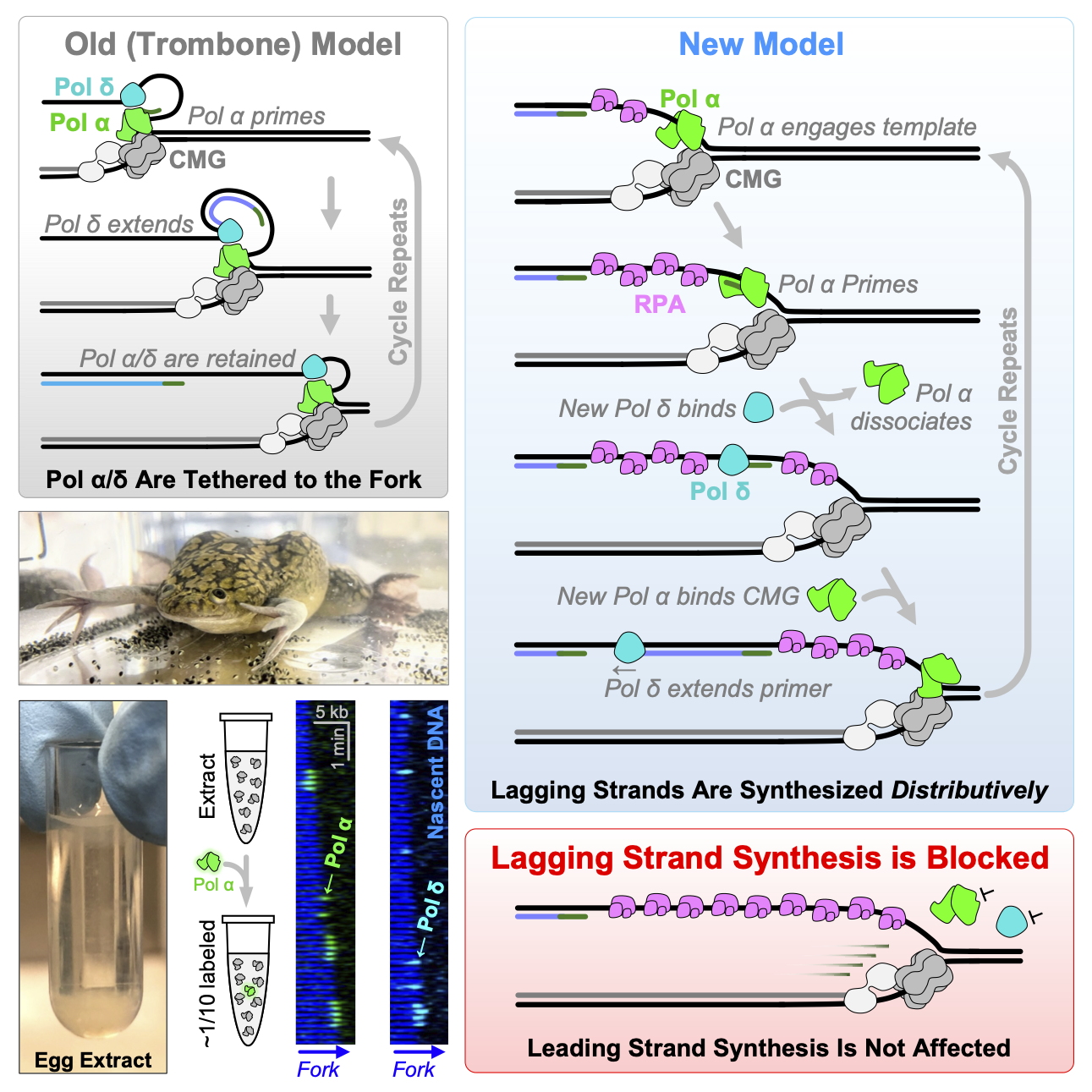
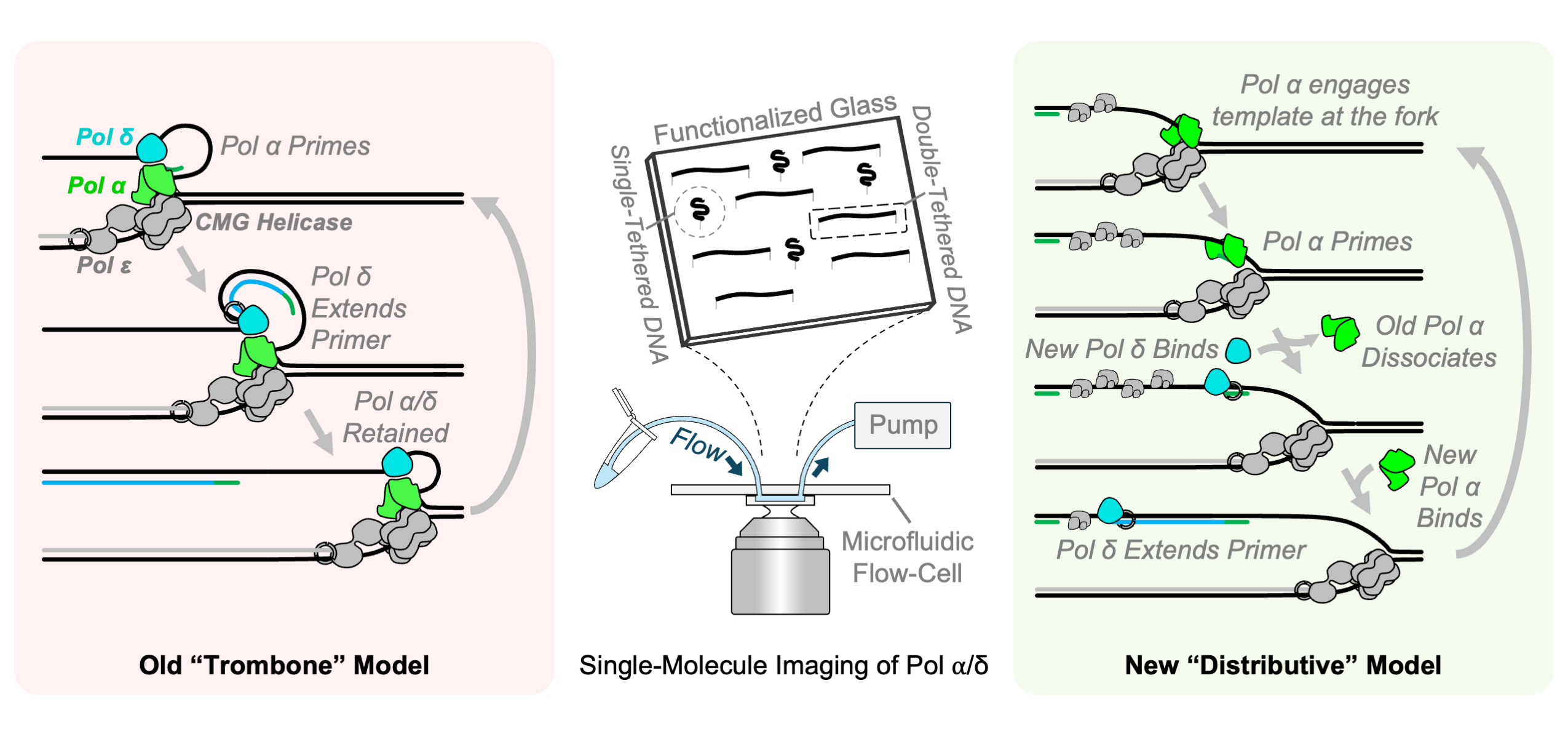
Our manuscript titled Metazoan lagging-strand DNA synthesis is distributive has been published in Cell (available online now). In this paper we revisit the textbook model of lagging strand DNA synthesis in higher eukaryotes, also known as the trombone model. It has long been thought/assumed that the lagging strand polymerases PolA and PolD are stably tethered to the replisome, and that the same PolA/D molecule is repeatedly reused to synthesize many (hundreds) of Okazaki fragments. In this study, Luke showed that neither PolA nor PolD are reused, and that each Okazaki fragment requires the recruitment of a new PolA and PolD molecule, challenging the widely-accepted trombone model. Our work illustrates how visualizing the dynamics of key factors involved in genome maintenance can overturn long-standing models in the field.
Congratulations to the first author - Luke Lynch (a graduate student in our lab, who recently started his postdoc in the Walter lab at Harvard Medical School) and to the second author - Jinho Park (a postdoc in our lab, who is now on the academic job market).
 Read More »
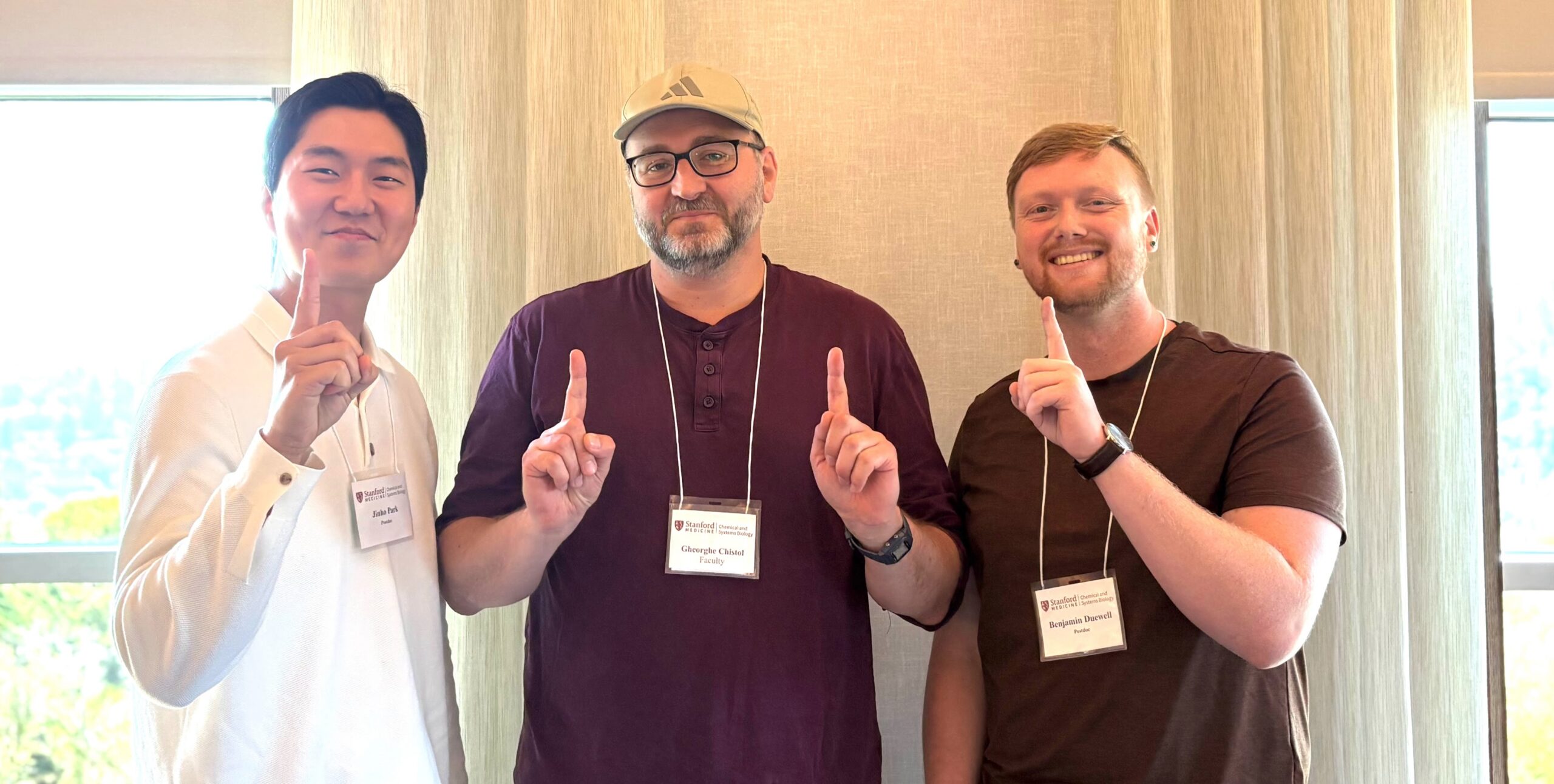
Our department held its retreat at the Chaminade Resort near Santa Cruz CA on Sept. 9-11 2026. Over 100 department members attended, with dozens of trainee talks and posters being presented. Each year the department awards "Best Talk", "Best Paper", and "Best Poster" prizes. We're delighted to announce that the Chistol lab "cleaned up" at this year's retreat: Dr. Benjamin Duewell received the "Best Talk" prize, while Dr. Jinho Park received the "Best Paper" prize (manuscript accepted for publication in Nature, still under embargo for the next ~month).
Congratulations to Jinho and Benjamin!!!
 Read More »
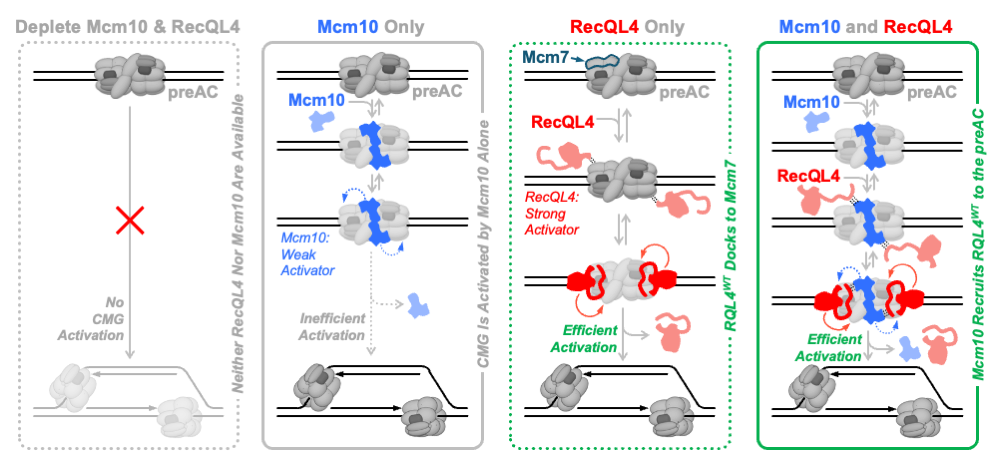
We are excited to announce that the "sequel" to our 2024 Cell paper has been accepted for publication in Nature Communications (September 2026).
Congratulations to the entire Replication Initiation Team!
 Read More »
Our lab is using real-time single-molecule imaging to (i) study how eukaryotes replicate/repair their DNA; (ii) dissect molecular mechanisms involved in maintaining large/complex genomes; and (iii) understand how multi-subunit molecular machines like the replisome are regulated.
We are looking for curious and highly-motivated undergrads, graduate students, and postdocs to join our team. Since our lab operates at the intersection of biology, chemistry, and physics - we welcome people with very diverse backgrounds, mindsets, skills, experience, and training . In addition to our bread-and-butter biochemistry and single-molecule imaging interests, we are now also interested in structural biology projects - if you are a prospective graduate student or postdoc candidate with extensive cryo-EM experience - pls contact us.
If you find our work exciting we encourage you to reach out by email at chistol@stanford.edu . If you are on campus you are always welcome to drop by the lab to chat.
Prospective Graduate Students
If you are applying to graduate programs at Stanford and are interested in our lab or department - pls contact us - it will be our pleasure to answer any of your questions.
Graduate Students
If you are a first year graduate student and are interested in a rotation - pls email us, or even better - visit our lab.
Postdoc Applicants
We are currently accepting applications for postdocs. Please see our Contact page for details on how to submit your application.
ADDRESS:
Chistol Lab
CCSR 3130, Mail Code 5174
Chemical and Systems Biology Department
Stanford School of Medicine
Stanford, CA 94305
Principal Investigator:
Gheorghe Chistol
chistol@stanford.edu
Tel: 650-498-1429
Administrative Associate:
Emma Atul
ehammock@stanford.edu
Tel: 650-725-0678
